

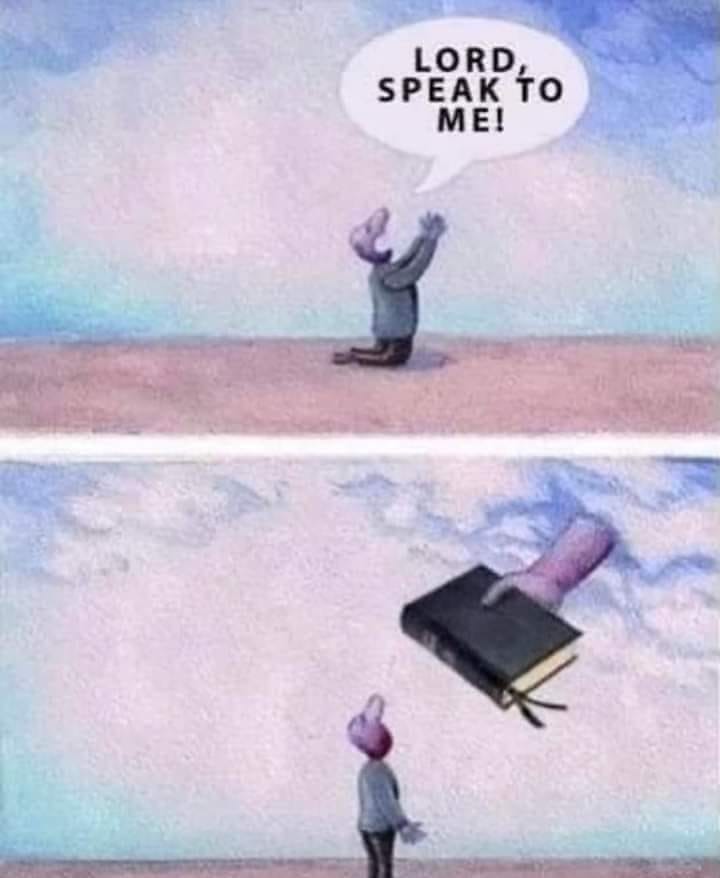
I see this meme frequently and on one hand there is truth in it that Scripture is a record of humanity’s interaction with God and within it we find the most accurate revelations of God’s nature, character, and desires for the world. This after all is why we refer to Scripture as “canon” – the measuring stick; canon means that it is by this revelation we can measure all other messages the Church receives from God. The difficulty is that most of the people who I encounter posting this meme seem to believe that God no longer is present in the Church speaking through the Holy Spirit and so the ONLY place to look is the Scripture. Further, these people often seem to believe that Scripture is somehow self-interpreting and therefore everyone can easily understand all of Scripture and apply it to the situations of the day. [Also, conveniently Scripture always seems to precisely support their beliefs .]
This idea that the Bible is the only source of God’s speaking and that an individual can interpret that for his or her personal dilemmas is something the Bible itself negates. Passages like John14:26 anticipate that the disciples will continue to learn from the Holy Spirit even after Jesus has left this world. And these passages written for the second generation of Christians are written in a way that indicates the Holy Spirit’s guidance is universal in the Church and so we should expect God to communicate to us through the Spirit. There should be an expectation among Christians that God will continue to communicate through the Holy Spirit because without this expectation it is difficult how we can claim that the Bible is accurate to say God will never leave us or forsake us (Hebrews 13:5). God consistently met the Old Testament Israel with prophets who spoke God’s message how can we claim anything less when we say Jesus has opened that same Spirit to all.
Further, this meme implies that an individual person can simply sit down and understand the Bible. While yes the Church has always taught that the average person can read and understand everything necessary for salvation in Scripture, that is very different from what the meme implies. Much in Scripture is difficult and any person who reads alone is simply going to confirm from Scripture what that one already believed and not hear from God. Yes, “have no fear” is very clear, but it is also very generic and like a charlatan’s prophecy can be applied to life a number of ways. When someone is praying to God for guidance and crying out, “Lord, speak to me” general advice does not cut it, that individual wants wisdom. [I am deliberately not talking about a person who cries out “Lord, speak to me” in pain or grief because I refuse to believe anyone would post this meme with those cries in mind. Clearly those individuals want God’s presence in a way no book can appease.] The cry, “Lord speak to me” is one of confusion, where the person needs clarity and precision not generalities. Reading Scripture can prepare us for life in some ways, but there are times where life is genuinely confusing and expecting memorized Scripture to be our sole guide is narrow minded. How are we to expect the Bible to apply easily to every situation in life? We cannot instead we must ask what does God expect, how does God expect to communicate with us?
First I look at God’s character and Jesus’ own words, God is deeply personal, appearing to people and responding to the cries of the needy, not just in Scripture but in the testimony of Church history. We know that it is God’s character to love and as Jesus said, “If you, then, though you are evil, know how to give good gifts to your children, how much more will your Father in heaven give good gifts to those who ask him!” (Matt 7:11). If I am willing to communicate and listen to my children how much more should I expect that God will listen and communicate with me. Those who post this meme are saying that God acts like a father who, when asked a question by his child, simply points to a written note and then disinterestedly goes back to what he was doing. Is that the model parent that I should expect God to be?
Of course not, but I think this reaction has arisen because culturally we expect prayer to be one-on-one, a private matter between me and God, where I ask questions and God responds. So naturally when that model proves ineffective people say, God already wrote the note and simply wants you to read it. Instead, I think the answer is in older models of Christian theology that saw these cries to God in a more communal light. Jesus, and the Biblical authors, expected the Holy Spirit to give us guidance but these expectations seem to be in a collective sense. The Bible says that we are to expect God’s direction in our lives but to expect it within the corporate life of our church. The problem is we often want to isolate ourselves with God, when God wants us to look to the body of believers. Yes, there is a time when opening to the Psalms and meditating on them is appropriate, yes there can be times when you feel God’s guidance on your own. However, when we look at the New Testament, the pattern is that God speaks to individuals through the small community of believers with whom that person is intimately connected. If we take away this concept and limit God to a book (even one as great as the Bible) we are severely limiting God’s power and presence, not to mention God’s love for us. While the Scripture is certainly our most consistent tool for helping to understand God and measuring our encounters with God, it is not a substitute for the real presence of God. We should expect that if we meet God in prayer then God will respond in a variety of ways that will intimately connect to our lives.
 Squinting in the Light
Leave a comment