

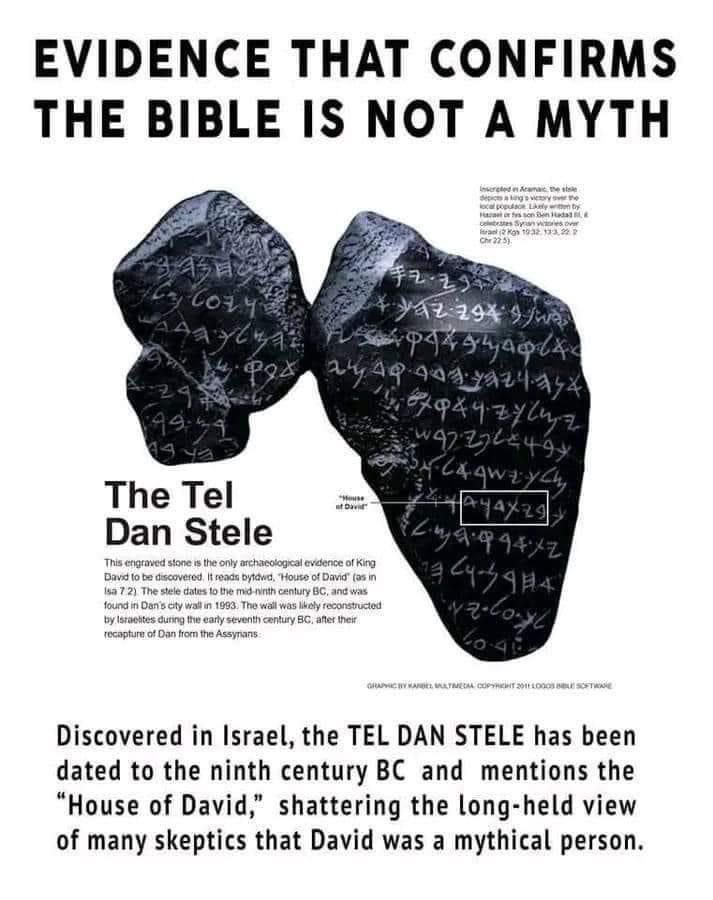
What do you mean the Bible is not a myth? Now, of course the whole Bible is not a myth but the Bible does contain myth and simply because we find archeological evidence confirming historical elements of the Bible does not change the fact the Bible contains myth. (Click the picture for a link to an article in Biblical Archeology Review about the Tel Dan stela and its inscription). From what I have read the Tel Dan stela is not without difficulties, but laying some of them aside, we can address what the inscription does and does not say, and then why it matters. The entire inscription is “house of David” and while this does refer to the same person that appears in 1 Samuel we need to be careful how we interpret that information. On its own this inscription does not prove David was a historical figure (let alone that the Bible is not a myth), it simply speaks of the house of David. This inscription is evidence that David was a historical king but it is not proof, since the inscription could be speaking of the palace in Jerusalem or Judah’s kings could have named themselves after a fictional figure (those these possibilities are less likely). Yet, even though this inscription does provide evidence for the historicity of David it does not then certify that all the stories in the Bible are historical and have not mythic qualities.
Now to understand why the Tel Dan stela does not prove anything about the Bible we need to understand what a myth is. We are often approach myths in school as fairy tales told by ancient cultures because they did not understand how the world works. Myths are understood as replacements for knowledge, and so if you believe a myth you are ignorant and simply lack in a true education. But that simply is not an accurate view of myths, myths are stories that we tell ourselves to help us understand the world around us, where we came from, and our ultimate ends. Myths are necessary parts of human existence because they help us maintain a hold on our place in the world. Myths are not falsehoods or lies, they are stories with meanings to show us purpose and thus a myth can be historical or at least have historical elements. History can be told in such a way that it ceases to be a good history and begins functioning as a myth. American history is often told in a way that eliminates the warts so that we are seen as overcoming hardships of the wilderness, and other major world powers to ascend to the dominant position in world politics where we are a champion for what is good and right. We tell stories of our heroes from George Washington to Martin Luther King Jr. in such a way as to highlight their good and noble characteristics while downplaying their flaws. This is myth-making, we are telling the stories of our nation and its leaders in ways that help us make sense of the world. These myths inspire us to maintain a specific character and give us expectations for the world around us. The American myth is that hard work leads to comfort, goodness leads to prosperity and that we can overcome hardship and injustice if we simply stand together.
And the Bible is the same way at points, particularly in the Old Testament, stories are framed in ways that are meant to teach us morality and have less concern for history. This does not mean that people like David did not exist or that the stories related about David in the Bible do not have a basis in history, it means that the history is being edited in such a way that we can more easily see the moral of the story- that David, like all kings, allowed the power of the position to consume and corrupt him and it ultimately destroyed him, his family, and the nation. This is a mythic element in the Bible and we should not shy away from that fact. If we forget that the Bible does at times teach with myth we forget to look for the lessons in the stories being told and simply skim through without pause. History does not teach us lessons, it is the interpretation of history and the construction of the stories and myths that teach us lessons and hold us to standards of character and we need to embrace this.
Such lessons can be difficult because we have been taught to disregard myths and so when we are attacked with the line “it’s just a myth” we respond, like the meme, with inaccurate statements. And the problem lies in the fact that we have not understood the distinction between history and myth. We implicitly accept that the story of the Bible is fundamental to our understanding of who we are as humans, but we then wrongly believe that the Bible has this authority because it records things just the way they happened. The mentality is that truth only comes if the events played out exactly as recorded no more, no less and if this is not true then nothing is true. Yes, it can be jarring when we are forced to recognize where our myths do not align with history (hence the battles over how American history is taught in schools), but this does not mean the mythic story is wrong, it simply means we had the wrong expectation of it. We thought the truth of the story lay in the fact that there was no other detail when the truth of the story was that it accurately reflected how the world operates. Recognizing this truth helps us understand what the Bible is and is not. And when we recognize where the truth of the Bible is we begin to approach it differently, not as a flat history book but as a rich story of God and God’s involvement with the world. Hopefully we can learn to be less frightened of the word myth, more accepting of what the Bible is and is not, and more nuanced in how we relate that to the world.
 Squinting in the Light
Leave a comment