

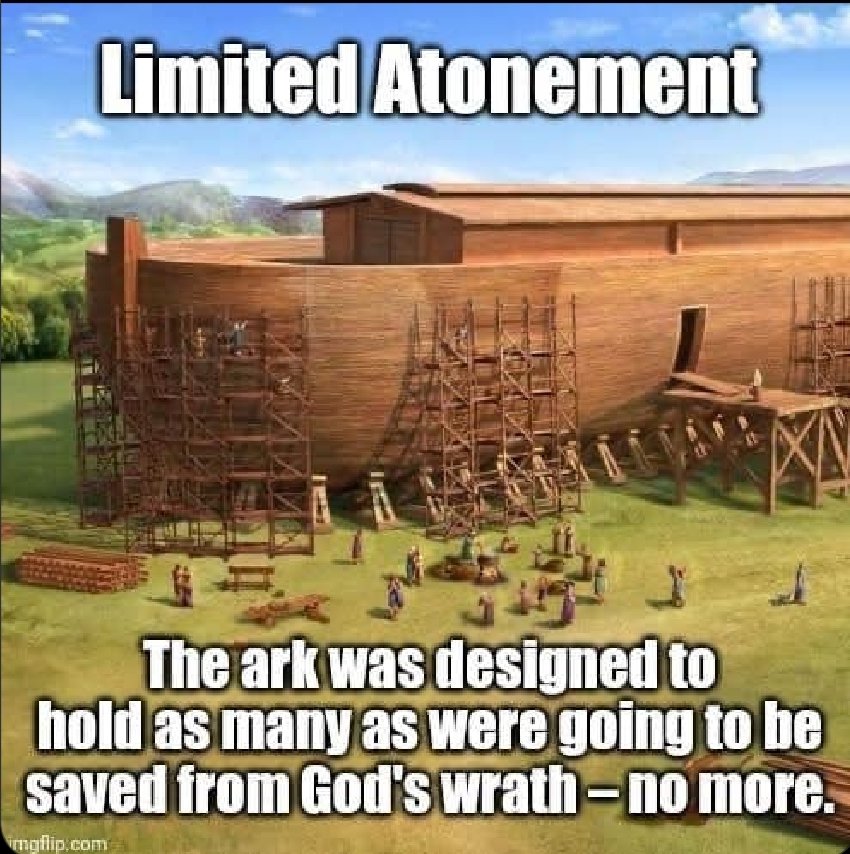
Meme theology is often so bad, and while I post my fair share of memes to social media (some might think I post too many) I try to stay in three categories: comic, Scripture, solid quotes. But memes that try to simplify theological statements like this often prove to simply be ignorant or false (this on is both). And that frustrates me because it makes Christians look intellectually weak and harms our ability to reach out to people.
For those of you who might not be aware the concept of limited atonement is one found in Reformed (think Presbyterian) circles and states, Limited atonement is a belief that Jesus’ death atoned for the sins of some people, but not all. In basic idea that God favors some with salvation but not others.This meme is trying to assert that the Ark was built just big enough for only the people that would survive and therefore God did not offer salvation to anyone else. Even though there are a host of problems and questions about the historicity of the story in Genesis 6-9 and the literary genre, I am going to lay those aside right now and assume the story as told from the perspective of the meme, which seems to be a literal historical approach.
So what is wrong with the meme? The short answer is that it makes a false assumption because it presumes limited atonement and so reads it into the text. The assumption is that because God told Noah to build an Ark and to take two of every animal, this was the only way God communicated with all of humanity and so God never intended to spare any other humans. This type of reading is often a problem when people approach the Bible, the Bible is written through the eyes of specific people and does not give a universal picture, but reads often assume it does give a universal picture.What that means is because we read of Noah’s encounter with God we assume that God had no other conversations or encounters with other people. But this is a faulty assumption, simply because we do not know of other conversations God had with other people does not mean that God had no other conversations with people. So, simply because God told Noah to build an Ark to save his family does not mean that God did not attempt to save others. In fact, Scripture would seem to indicate the opposite. We could point to 2 Peter 2:5 as a witness that Noah preached the coming flood and so demonstrated that God was trying to save others, but that passage is not as clear cut as might appear at first glance and I do not want to fall into the same proof texting fallacies that led to the meme. Instead, I will use 1 Timothy 2:3-4 which is a clearly articulated vision of God’s character that is consistent with the rest of Scripture:
This is good and pleasing in the sight of God our Savior, who wants all people to be saved and to come to the knowledge of the truth.
If this verse clearly says that God’s character dictates that God desires all people to be saved, how can we say otherwise. But what do we do with the Noah story? Simple, we lay aside the assumption that God’s entire plan was only to save Noah and his family and assume that God reached out to others and offered them opportunities at salvation that we are not aware of because the Scriptures are not concerned with those individuals but wanted to relate Noah’s story and Noah’s story alone. Basically the meme only works if we start with the assumption that God only desires to offer salvation to a select group and then read that story into the Bible, if we reject that story as a starting premise, the Noah story does not teach it.
 Squinting in the Light
Leave a comment