
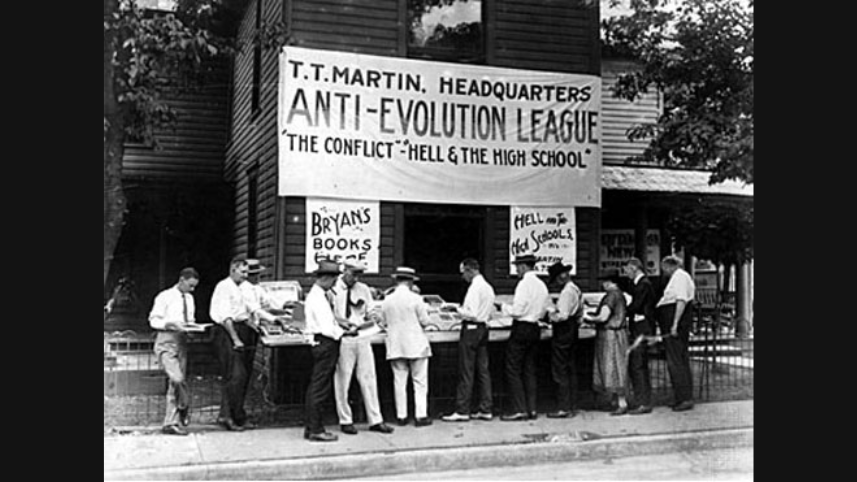
July 21 marks one hundred years since a jury found John Scopes guilty of violating the Butler Act and fined him $100. I have been thinking about this trial recently and how even though the Fundamentalists won the trial it was ultimately a major loss. I find the Scopes trial is one of those events that does not simply live in the past but has echoes up to this day. It also has a valuable lesson for us as we negotiate our time. The public perception of the trial was that it was Christianity (prosecutor William Jennings Bryan a committed Christian) vs atheism (defense counsel Clarence Darrow an agnostic).1 In the minds of many Christianity became associated with the Fundamentalists who had pushed for the Butler Act, which may have been popular in Tennessee but was not across the country.
But this perception is not the entire story. A major part of Darrow’s defense of Scopes was that there were many Christians who saw no conflict between Christianity and evolution. Individuals like Maynard Metcalf, a zoologist, were called to testify about their acceptance of both Christianity and evolution. Darrow’s argument had two impacts. First was to show that the evidence for evolution was so compelling that Christians in science accepted it. And Second, that there was no inherent conflict between Christian truth and biological truth. This avenue of his defense was to show the Butler Act was not interested in truth but in control. And this became the public perception, Christianity especially conservative Christian became associated with control. Bryan and others thought they were defending truth but in the end sacrificed truth for control. Even today the Christian Nationalist successors to the Fundamentalists are worried about control while sacrificing the truth of Christianity.2
The Butler Act is an example of what Christian Nationalists are promoting (many explicitly want laws banning the teaching of evolution). It is an example of one Christian group exerting control over society (even other Christians) in a way that did not allow for a discussion about truth and ultimately the backlash harmed the Christian witness. The worst part is that the Christians who promote this ideology fail to see how they are failing. The Young Earth Creationists who passed the Butler Act saw their beliefs as true and their opponents as false. So of course there is no promoting with promoting what they saw as true and banning what they saw as false. The problem is the Christians who were in control in Tennessee prioritized a tribal and trivial goal without listening to others. The result was the question of truth was less important because all others saw was the attempt to control and rejected that.3 4 What this attempt at Christian Nationalism did was to prioritize a belief held by a faction of Christians to such a level that it alienated a large portion of society and helped harden them against Christianity. A very similar outcome happened with Prohibition, where a segment of Christians pushed a law that ultimately caused others to harden themselves against the Christians they perceived as controlling.
Here we are a century later and Christian Nationalists (and YEC organizations) are still trying to replicate this mistake. They are still trying to simply pass laws to push “Christian morality” without considering how those laws are going to impact their witness. Yes, occasionally these groups will win a legal victory, as happened in Dayton Tennessee, but the cost will be public perception and a witness to society around us.
- The case was about the Butler Act a law in Tennessee that made it illegal to teach human evolution. John Scopes was a substitute teacher who could not remember if he had actually ever taught human evolution but volunteered to be prosecuted so the ACLU and Darrow could challenge the legality of the Butler Act. His conviction was later overturned on a technicality. The Butler Act was ultimately repealed in 1967. ↩︎
- Not every person who believes young earth creationism is a Christian Nationalist but there is considerable overlap between Young Earth Creationist organizations and the Christian Nationalist movement. Kathleen Oberlin demonstrates this (though does not explicitly make the connection) in her description of the YEC dependence on Christian politics Creating the Creation Museum ↩︎
- As always my intention here is not to promote either YEC or Evolution, I do not feel qualified enough in science to make a public statement on the issue. ↩︎
- I know someone believing themselves clever will oppose what I am saying about Christian Nationalism with the comment “doesn’t that mean we can’t have laws against murder”. Such ideas are a motte and bailey fallacy where instead of arguing about the topic at hand one retreats to a more easily defensible position and assumes that defending that position equates to defending the actual topic at hand. This is a common tactic used by Christian Nationalists. But the reality is that what I am opposing is using government for overtly Christian positions such as creationism rather than more universally accepted moral and social ideals. ↩︎
 Squinting in the Light
Leave a comment