
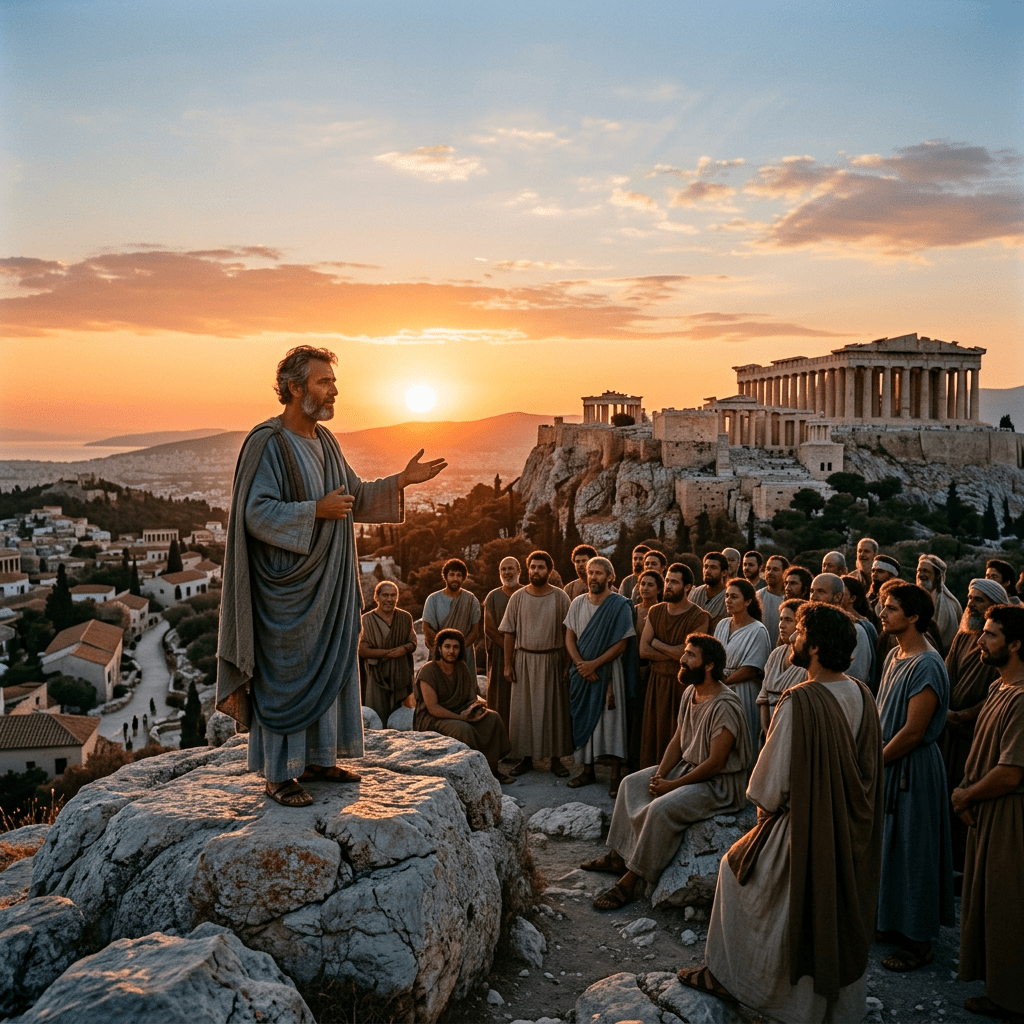
Scripture: Acts 17:22–31
22 Then Paul stood in front of the Areopagus and said, “Athenians, I see how extremely religious you are in every way. 23 For as I went through the city and looked carefully at the objects of your worship, I found among them an altar with the inscription, ‘To an unknown god.’ What therefore you worship as unknown, this I proclaim to you. 24 The God who made the world and everything in it, he who is Lord of heaven and earth, does not live in shrines made by human hands, 25 nor is he served by human hands, as though he needed anything, since he himself gives to all mortals life and breath and all things. 26 From one ancestor he made all nations to inhabit the whole earth, and he allotted the times of their existence and the boundaries of the places where they would live, 27 so that they would search for God and perhaps grope for him and find him—though indeed he is not far from each one of us. 28 For ‘In him we live and move and have our being’; as even some of your own poets have said,
‘For we too are his offspring.’
29 Since we are God’s offspring, we ought not to think that the deity is like gold, or silver, or stone, an image formed by the art and imagination of mortals. 30 While God has overlooked the times of human ignorance, now he commands all people everywhere to repent, 31 because he has fixed a day on which he will have the world judged in righteousness by a man whom he has appointed, and of this he has given assurance to all by raising him from the dead.”
Questions
- Why does Paul bring up the shrines and the distinction of different peoples?
- Which Groups within Athens might Paul be appealing to and which poets is he alluding to?
- What does repentance mean in this context, is Paul making a general statement or speaking of specific actions?
Background
Related Scriptures: 1 Peter 3:13–22
Chrysostom: He did not find in the city a holy book but an altar to an idol with the inscription “To an unknown god.” The holy Paul, who had the grace of the Spirit, did not pass by but turned the altar with its inscription on its head.… He did not omit what the idolatrous Athenians had written.… We see what great value that inscription produced.… Paul entered the town, found an altar on which the words “to an unknown god” were engraved. What did he have to do?… Did the words of the Gospels need to be declared? They would have mocked them. Or maybe the words from the books of the prophets or from the precepts of the law should have been talked about? But they would not have believed. What did he do then? He rushed to the altar and defeated them with the weapons of the enemies themselves. And that was what he said, “I became everything to everyone: to the Jews a Jew, to those outside the law as if I were outside the law.”[1]
Reflection
There is no place in Paul’s life that emphasizes his commitment to be “all things to all people” more to me than Acts 17. In this chapter Paul sits down with the philosophers of Athens. To most Christians reading Paul’s speech may seem like a conventional presentation of Christian beliefs based around an “unknown god”. However, Paul’s words would have rang deeper for those who listened to him. Paul made great effort to reach his hearers where they were and in language they could understand. And the result was they invited him back to sit and teach more. While on one hand we may disregard this because we are not told of many conversions, the point of the story is that when he spoke, they listened and gave his message a hearing. After all, our job is to proclaim the Gospel as effectively as we can, not to force others to believe.
Paul’s speech, especially in English, sounds like a typical Christian preacher proclaiming the tenets of the faith. But in this short speech are words that would have had meaning specifically for the Stoic philosophers present. Paul used language that overlapped with what the philosophers believed as well as quoting one of their own, Aratus. Judging from the limited snippet we are given Paul did not simply give a cursory nod to the Stoic beliefs but took the time to engage with their ideas. That is Paul was confident enough in his own understanding of the truth that he listened to the Stoics to understand what they believed. And when he engaged them, he did not jump to disparaging their ides but began with finding common ground. I think this is important, Paul took enough time to listen to those he wanted to engage with, to understand where they were and what they understood. It must have taken Paul a significant amount of time listening to other teachers to come to a place where he understood what they were teaching before he could be prepared to speak.
Second, Paul did not begin by criticizing the philosophers’ beliefs, rather he begins by finding common ground. Paul learned to look for places where the philosophers were already close to Christianity so that he could draw them further down that path. Paul did not create undue confrontation, instead he looked to begin with emphasizing the similarities between himself and the philosophers. I think Paul understood that there would be differences in opinions and disagreements with the philosophers. Knowing there would come times of disagreement and difficulties does not mean that Paul had to bring those confrontations to the fore immediately. Instead, he was able to begin with the common ground understanding this gave him the best chance of being heard. Why is it that most people scoff at sidewalk preachers? Because those individuals often focus on the faults of those passing by and come across as hateful. Of all the things the people in Athens might be able to say about Paul this was certainly not an accusation they could make. Instead, they would understand where Paul praised them and even if they disagreed with him, they would know how their current beliefs worked within the system he presented.
This passage in Acts shows us how Paul respected people where they were and sought to find common ground with them. This does not mean he negated the distinctive message of the Gospel, but that he eased people into it. Paul was wise enough to understand how his words would be heard by the people around him and took seriously the need to speak well. This included taking the time to understand what others believe and where he could meet them. This is a staggering difference from where so many are today. Too often we emphasize the differences and that leads to people feeling distanced from us. Christians are meant to be welcoming inviting others to join us on the journey toward Jesus. The important lesson for us is who Paul is trying to reach and how he accomplishes that. He provides us with a model of respect that allowed him to have multiple conversations with people and plant the seed of the Gospel in their minds.
[1] Francis Martin and Evan Smith, eds., Acts, Ancient Christian Commentary on Scripture 218.


Leave a Reply