
Scripture: Matthew 13:31–33, 44–52
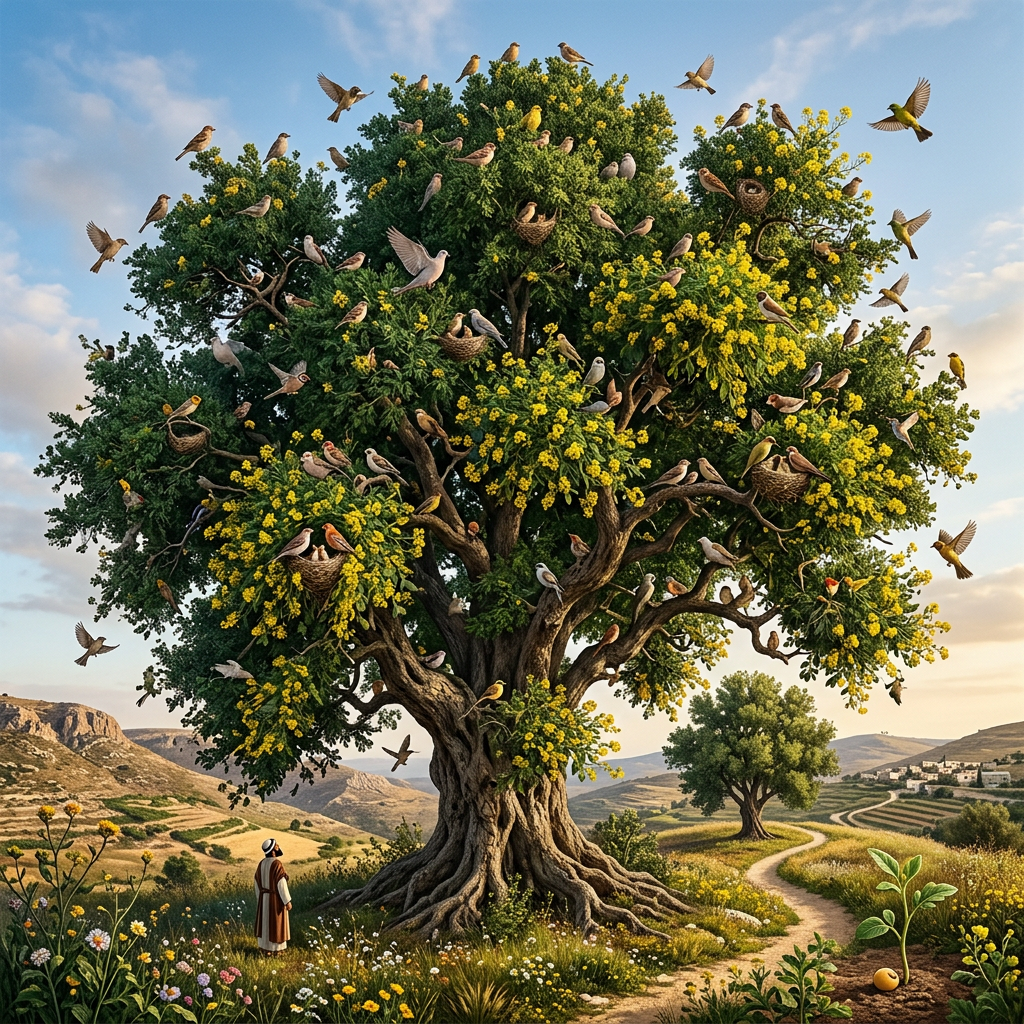
31 He put before them another parable: “The kingdom of heaven is like a mustard seed that someone took and sowed in his field; 32 it is the smallest of all the seeds, but when it has grown it is the greatest of shrubs and becomes a tree, so that the birds of the air come and make nests in its branches.”
33 He told them another parable: “The kingdom of heaven is like yeast that a woman took and mixed in with three measures of flour until all of it was leavened.”
44 “The kingdom of heaven is like treasure hidden in a field, which someone found and hid; then in his joy he goes and sells all that he has and buys that field.
45 “Again, the kingdom of heaven is like a merchant in search of fine pearls; 46 on finding one pearl of great value, he went and sold all that he had and bought it.
47 “Again, the kingdom of heaven is like a net that was thrown into the sea and caught fish of every kind; 48 when it was full, they drew it ashore, sat down, and put the good into baskets but threw out the bad. 49 So it will be at the end of the age. The angels will come out and separate the evil from the righteous 50 and throw them into the furnace of fire, where there will be weeping and gnashing of teeth.
51 “Have you understood all this?” They answered, “Yes.” 52 And he said to them, “Therefore every scribe who has been trained for the kingdom of heaven is like the master of a household who brings out of his treasure what is new and what is old.”
Questions
- Are there a theme or themes that run through all of these parables or are these parables creating a multi-faceted mosaic of the kingdom?
- Today we recognize the mustard seed is not the smallest seed but would it have been for people of Jesus’ day?
Background
Related Scriptures: Ezekiel 17:22-23; Daniel 4:12; 1 Corinthians 3:1-8
We are meant to read Jesus’ comment about mustard being the smallest seed as poetic license, he is contrasting the small beginning with the large and productive plant it grows into.
While Jesus’ comment about the kingdom of God is unique several other ancient sources used the size of a mustard seed as a parable.
Hilary: The Lord compared his reign with a grain of mustard seed, which is very pungent and the smallest of all seeds. Its inherent potency is heightened under stress and pressure. Therefore, after this grain is sown in the field—that is, when it has been seized by someone and delivered up to death as though buried in the field by a sowing of its body—it grows up to become larger than any herb and surpasses all the glory of the prophets.[1]
Reflection
I think it is intentional that we are not given explanations to these parables, I believe that is so we have more freedom to make connections of our own. Yes, in some ways the explanations seem obvious, but the longer you sit with these parables the more they work into you and grow and when they do this they become a greater treasure. In other words these parables become and example of the kingdom in our own lives. As sat down to read about how Christians have understood these parables throughout history I found the interpretations vary widely the message itself spread into different areas. And when I recognized that these simple stories took on a new value in my own thinking and life. I started to look at these words as practice for witnessing the kingdom in the world. It can be easy to read simple parables like these and think we understand them completely but the reality is the more time we spend with them the more they can teach us. Meditating on Jesus’ words I began to appreciate new elements of the message. I realize that we all, myself included, value certainty, but these parables are a safe space to expand our ideas and thinking, to allow our imaginations loose. These parables provide us the freedom to ask what does God’s reign look like in my world. How has it spread? What is it sheltering? How is it hidden? How is it treasure? What am I sacrificing to find it?
As I said, I think this is why Jesus left these parables unexplained, because they are an exercise in opening up our minds to reflection. Sowing seed and adding yeast to dough are very normal activities they are part of ordinary life for millions of people. Imagine hearing these parables and going home walking past your mustard plant or making sourdough. Your appreciation for Jesus’ words would certainly increase and you would probably start to consider, “what is my part in God’s reign, where do I fit in this process?” Am I the person sowing seed, the person mixing in the sourdough starter, or am I the seed, or starter? Am I maybe the field or flour which blossoms because of someone’s work? Or maybe I am all three, how would this work?
All these questions are meant to help us look deeper into our own lives to find what God is doing in us. When I am struggling I might ask what Mustard seed am I nourishing. When I am witnessing to a friend I might realize that I have planted the seed and trust God to produce the harvest. I might think about my life and see how that initial starter mixed into my life has spread and changed me to be more like God. I might consider what is so special about God’s reign that I am willing to sell everything I have to gain it.
Jesus wants us to realize that God’s reign is all around us waiting on us to wake up and recognize the reality of it’s presence. We are meant to hear these parables and start looking for God’s reign recognizing that the more we meditate on its presence the greater a reality it will be for us. As we look for God in our lives God’s presence will grow in our lives. As we look for God’s reign in our communities we will begin to bring God’s reign into our communities. As we search for the treasure in the world we will begin to find it and begin to sacrifice our goods just to have it.
Jesus’ parables are windows into ourselves that help us discover where our focus is. We are meant to take these aspects of life and relate them to our day so that we can continue to grow and develop. We are meant to sit with these pictures asking ourselves about all of the possibilities that Jesus could have meant and how each one relates to our world.
With this in mind, here are the questions I have asked myself as I have meditated on these verses this week. What is the small seed in my life that God wants to grow? How can I be the starter for my community that will help leaven the whole? What is the aspect of God’s reign in this world that I treasure most and how am I going out of my way to possess it?
[1] Manlio Simonetti, ed., Matthew 1–13, Ancient Christian Commentary on Scripture 280.


Leave a Reply