
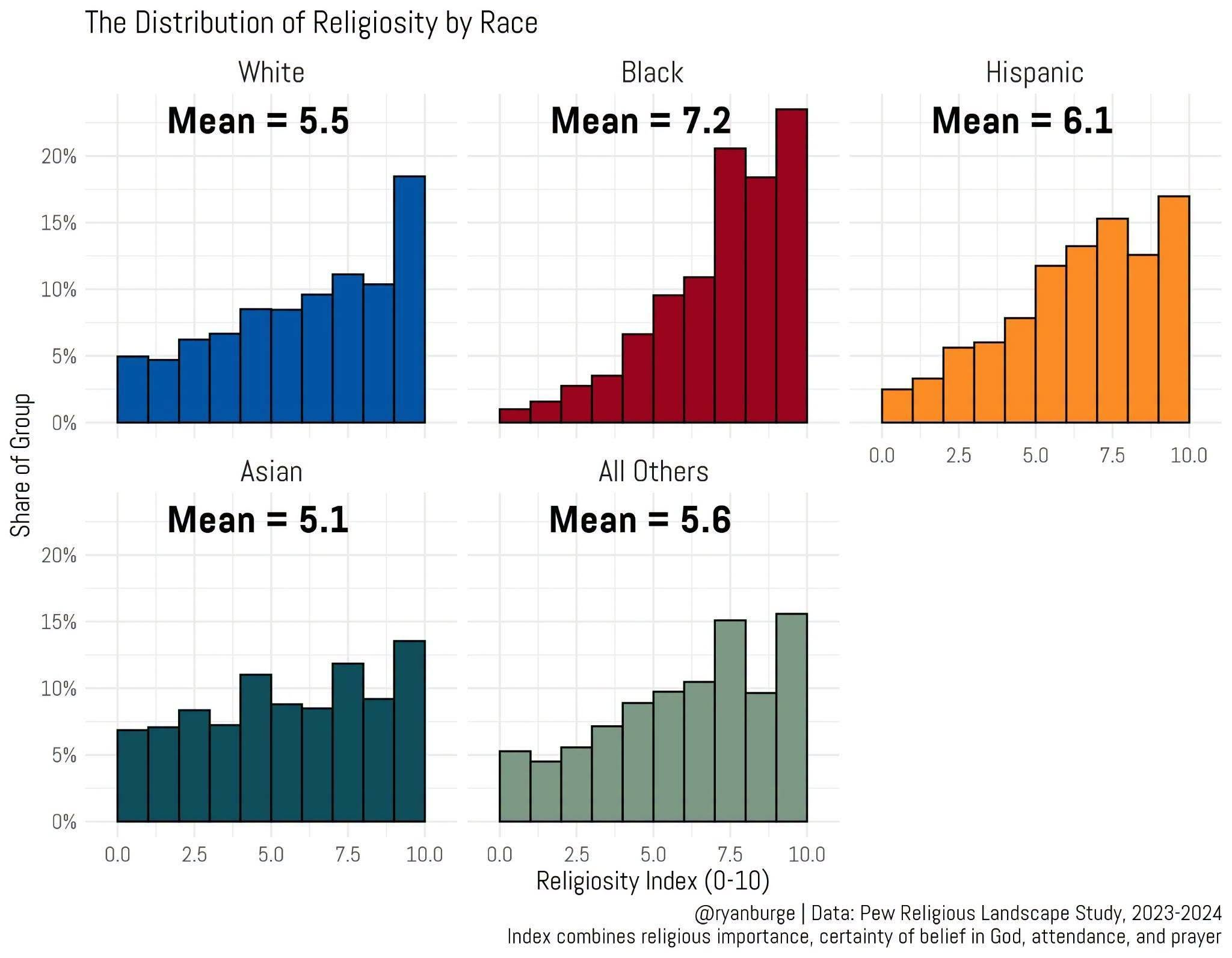
TThis graph is fascinating to me for several reasons. Credit is due to Ryan Burge and his work; I recommend reading his Substack post for the full context.
One reason this graph stands out is the contrast between the data and a claim made by Stephen Wolfe, author of The Case for Christian Nationalism:
“White evangelicals are the lone bulwark against moral insanity in America.”
Wolfe takes this claim seriously enough that it has become a catchphrase associated with his website and podcast. Yet the data in this graph directly challenge that claim. The three most religious racial groups in the United States are non-white, and the two most religious groups are predominantly Christian. Whatever else we might conclude from these numbers, it is difficult to maintain that white evangelicals are the “lone bulwark” of religious or moral life in America. The evidence suggests they are not even the largest bulwark.
I suspect, however, that this research will not change Wolfe’s argument because his position is not ultimately based on religious participation. It is rooted in a broader understanding of nationhood, culture, ethnicity, and human flourishing.
Wolfe explicitly argues that a nation requires a shared cultural heritage. In his response to the PCA report on Christian Nationalism, for example, he argues at approximately the nine-minute mark that a common heritage is necessary for human flourishing. He has also repeatedly argued that human and societal flourishing requires groups to share a common culture and heritage.
This helps explain how “white evangelicals” can remain the “lone bulwark” in Wolfe’s framework even when the data show that non-white Christians are among the most religious groups in America. If human flourishing depends upon a particular shared cultural heritage, then Black and Hispanic Christians cannot simply be counted as part of the same “bulwark” if they do not share the Anglo-American cultural heritage that Wolfe considers essential.
This is also why Wolfe’s disagreement with the PCA statement on Christian Nationalism is more fundamental than a disagreement over terminology. At its core, Wolfe believes that shared cultural heritage is necessary for societal stability and human flourishing. The PCA rejects that premise as a necessary component of Christian Nationalism, and therefore rejects the broader argument that Wolfe builds upon it.
Is This Ethno-Nationalism?
Wolfe rejects the characterization of his beliefs as a form of ethno-nationalism, and he has said that he does not know what “ethno-nationalism” means. So it is worth looking at the definition and allowing readers to judge for themselves how closely Wolfe’s understanding of nationhood corresponds to it.
One definition describes ethno-nationalism as:
“The belief, theory, or doctrine that shared ancestry is the principal element of a cohesive national identity, and that a government should protect and promote the culture, language, and religion of one group, considered the primary or prestigious people of a nation, over other cultures, languages, or religions that may share that space in a multicultural society.”
Wolfe may genuinely reject the term, or he may not understand the terminology. But that does not resolve the question of whether the ideas he advocates fit the definition.
In my view, his arguments in response to the PCA report clearly place his ideas within this framework. He repeatedly argues that shared cultural and ethnic heritage is essential to societal stability and human flourishing. The terminology may be uncomfortable, but rejecting the label does not necessarily invalidate its applicability.
What I find particularly troubling is the way Wolfe appears to move between two different presentations of his argument. When making a positive case for Christian Nationalism, he emphasizes the importance of shared ethnic and cultural heritage. When responding to critics who characterize those ideas as ethnocentric or ethno-nationalist, he tends to distance himself from those implications.
That distinction matters because many people are attracted to the idea of “Christian Nationalism” because they understand it as a defense of Christianity against secularism or non-Christian religion. But if Wolfe’s argument is actually about preserving a particular Anglo-Protestant cultural heritage, then the issue is fundamentally different. It raises serious questions about whether his vision is truly about Christianity as a religion or about Christianity as an expression of a particular ethnic and cultural heritage.
His position on interracial marriage illustrates the problem. Wolfe has explicitly argued that interracial marriage is sinful. Yet when challenged on this position, he sometimes redirects the discussion toward examples involving Christian and non-Christian marriage. But those are not the same argument.
The issue is not simply whether Christians should marry non-Christians. Wolfe’s stated concern is that marriage between Christians of different ethnicities can create cultural tensions and undermine the preservation of a shared cultural heritage. If that is the argument, then ethnicity itself—not merely religious compatibility—is being treated as morally significant.
That is precisely why the question of ethno-nationalism matters. It is not merely a semantic dispute over labels. It is a question about whether ethnicity and inherited cultural heritage should determine who belongs together, what constitutes a nation, and what conditions are necessary for human flourishing.
What the Data Actually Show
The data present a significant problem for the claim that white evangelicals are uniquely responsible for preserving religious or moral life in America. In fact, the evidence points in the opposite direction: some of the country’s most religious communities are racial and ethnic minorities, many of whom are Christians.
If religious participation is one measure of religious vitality, then America’s ethnic minorities are not a threat to that vitality. They are a significant part of it.
And that creates a difficult question for Wolfe’s argument: If Black and Hispanic Christians are among the most religious Americans, why should they be excluded from the “bulwark” defending America’s moral and religious life?
The answer cannot simply be that they are less committed to Christianity. The data suggest otherwise.
The more plausible explanation is that Wolfe’s definition of the necessary cultural heritage is narrower than Christianity itself. And if that is the case, then what is being defended is not simply Christianity, but a particular ethnic and cultural expression of Christianity.
That distinction deserves much more scrutiny than it currently receives.


Leave a Reply