
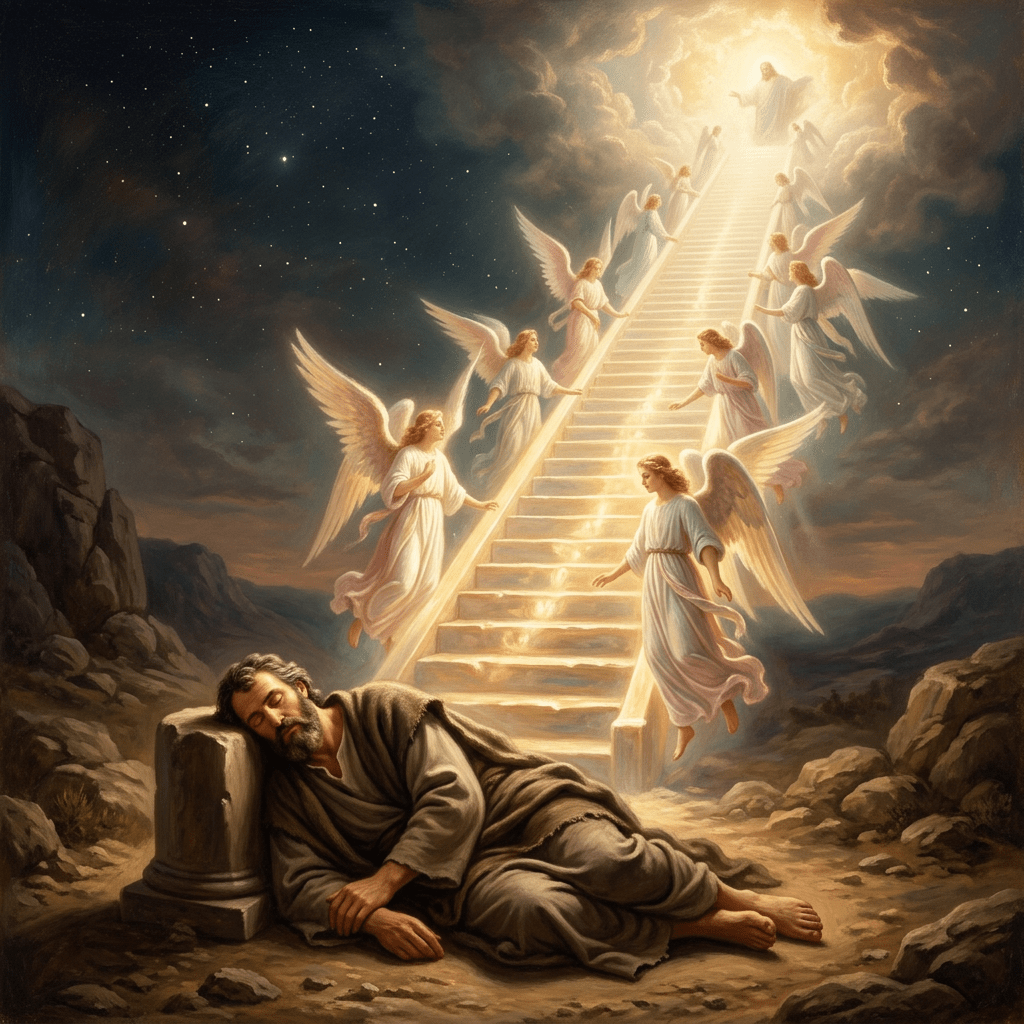
Scripture: Genesis 28:10–19a
10 Jacob left Beer-sheba and went toward Haran. 11 He came to a certain place and stayed there for the night, because the sun had set. Taking one of the stones of the place, he put it under his head and lay down in that place. 12 And he dreamed that there was a ladder set up on the earth, the top of it reaching to heaven; and the angels of God were ascending and descending on it. 13 And the Lord stood beside him and said, “I am the Lord, the God of Abraham your father and the God of Isaac; the land on which you lie I will give to you and to your offspring; 14 and your offspring shall be like the dust of the earth, and you shall spread abroad to the west and to the east and to the north and to the south; and all the families of the earth shall be blessed in you and in your offspring. 15 Know that I am with you and will keep you wherever you go, and will bring you back to this land; for I will not leave you until I have done what I have promised you.” 16 Then Jacob woke from his sleep and said, “Surely the Lord is in this place—and I did not know it!” 17 And he was afraid, and said, “How awesome is this place! This is none other than the house of God, and this is the gate of heaven.”
18 So Jacob rose early in the morning, and he took the stone that he had put under his head and set it up for a pillar and poured oil on the top of it. 19 He called that place Bethel; but the name of the city was Luz at the first.
Questions
- Why does God visit Jacob when he is running away from his family in fear and some disgrace?
- Why would Jacob’s vision make him think that Bethel was the gate of Heaven?
- How should we consider the irony that Jacob views Bethel as God’s location when God tells Jacob, “I will not leave you”?
Background
Related Scriptures: Genesis 1:1-2:3; Romans 8:12-25
This story is the opening of Jacob’s encounters with God and as him as a patriarch. Prior to this he was under his father’s care, now that he is striking out on his own he experiences God personally. The point is that even though Jacob is running away from his problems in fear God is not abandoning him but going to attempt to work with him to bring him back to where he belongs.
The site is nameless when Jacob stops it is only after Jacob names it that its former name is given. The point is that the region’s name is important because it relates back to God.
Chrysostom: Notice here, I ask you, the extraordinary care of the loving God. When he saw [Jacob] consenting to the journey in accordance with his mother’s advice, which came out of fear of his brother, and taking to the road like some athlete, with no support from any source, leaving everything instead to help from on high, Christ wanted at the very beginning of the journey to strengthen Jacob’s resolve. And so he appeared to him with the words “I am the God of Abraham and the God of your father Isaac.” I have caused the patriarch and your father to experience a great increase in prosperity; so, far from being afraid, believe that I am he who fulfilled my promises and will shower on you my care.[1]
Reflection
I imagine that Jacob would have found his dream an odd mixture of comforting and terrifying. On one hand he was encountering God in a new and exceptional way which would be thrilling but at the same time he must recognize that he was not prepared for the level of God’s presence and the sanctity of the field where he was lying, I am guessing that as Jacob was leaving his home and the places he had known, it would have been a comforting message that God was with him. But at the same time not realizing how present God was would not have been an easy thing to process. But the overall impact on Jacob seems to have been positive, he left Bethel understanding God’s presence was there and that God wanted to have a relationship with him.
Not only is it comforting to read a story where God is present with Jacob as he is striking out on his own for the first time, but it becomes even more comforting when I think about the fact that Jacob had flaws. The stories of Jacob and his family are filled with lies, deceit, greed, fear and the lingering threat of violence. These are hardly stories of people we would identify as models of saintly behavior. And yet it is precisely these people who God speaks to and wants to work with. I think a large part of the patriarch narratives are about God choosing to work with people just like us. These stories show us how God works in spite of these characters and when possible, with them and through them. We are supposed to understand them as we do ourselves, people who are deeply flawed trying to understand life. And in this passage God shows up as Jacob is fleeing home in fear for his life and shows him that there is so much more to the world than he understood.
Jacob is unaware of the fact that God’s dwelling place, what we might call heaven, is all around him waiting on him to fully open his eyes to God. This is a template for us, where we get so caught up in our lives that we fail to see the reality that heaven is all around us. We fail to see that sacred space is everywhere, and God’s presence is everywhere. We, like Jacob, can get caught up in our lives to such an extent that we do not even consider the larger reality of life. This is what Paul wants us to consider in Romans 8. There he talks about how all of creation is waiting for God’s restoration, and we who are growing in the fruit of the Spirit share in the expectation. He wants us to recognize that all of Creation is meant to be like the Garden of Eden and that we are waiting for the day when God brings this about. Further, he wants us to consider that if we are truly living with God and producing the fruit of the Spirit then we are not just longing for that day but actively working with God to see it accomplished.
God shows Jacob the vision of heaven not simply to comfort Jacob as he flees from his brother, but also so that Jacob understands that he is supposed work with God to maintain the holiness of the land he inhabits. God wants Jacob to have such a powerful vision that he meditates on it for years, thinking about what it means that he saw God’s house and how that should impact him. This should lead him to consider both what it means that God is with him, and how he should act in God’s presence and what it means for the land to be God’s house.
We may never have a vision like Jacob’s, but we have similar glimpses given to us in the Bible. We see that God wants to be with us in the same way. We see that God opens up sacred space to us. We see that God wants to bless us and be near us. Perhaps we too are like Jacob and come from a place that does not seem to strongly reflect God’s character. But that is not meant to hinder us, the vision God gives us of the coming world is meant to inspire us to be more like God. It is meant to invigorate our desire to make creation more like Eden. And to help us desire to be like God so that we are prepared for the coming reality Paul looked forward to. Our goal is to help make this world like heaven so that when our heaven comes we are ready for it.
[1] Mark Sheridan, ed., Genesis 12–50, Ancient Christian Commentary on Scripture 191.


Leave a Reply