Scripture: Revelation 7:9–17
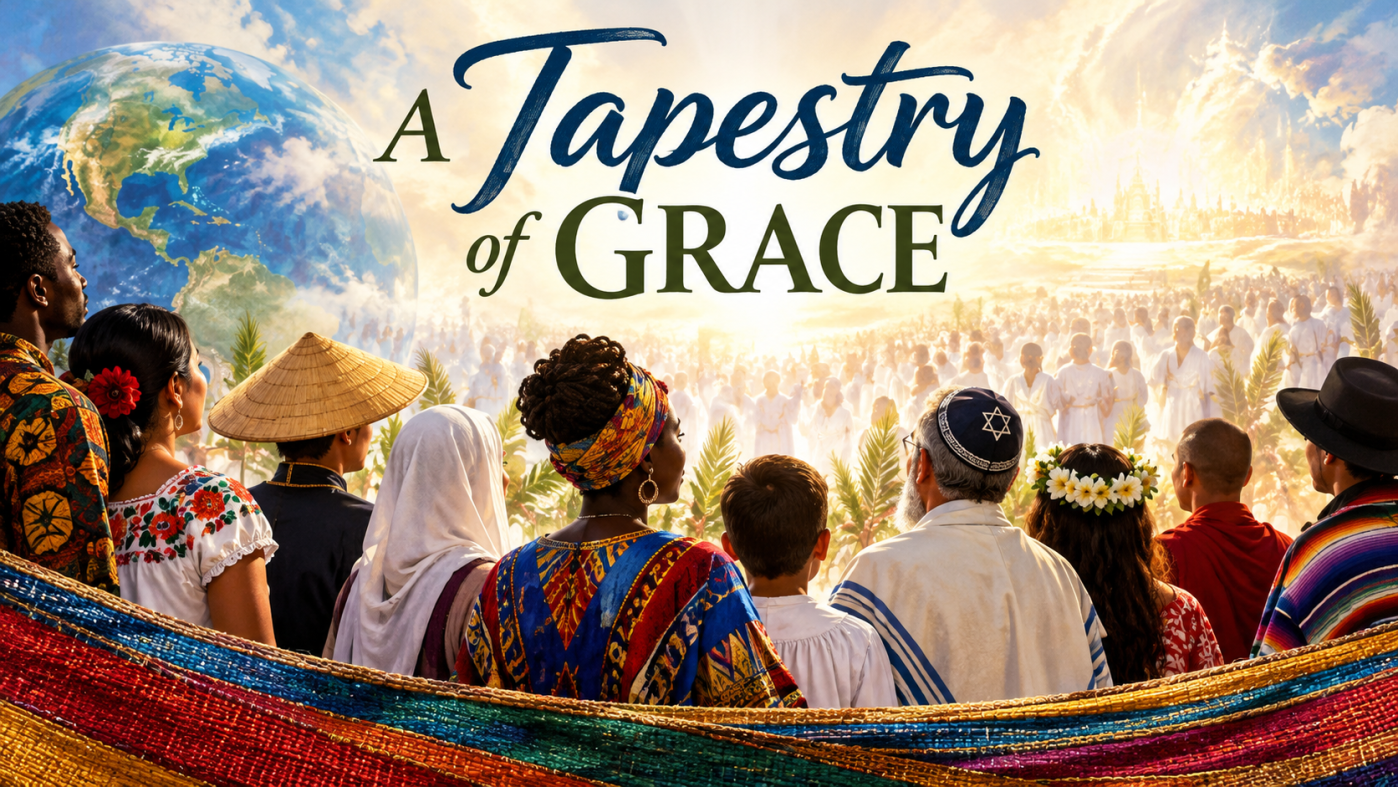
9 After this I looked, and there was a great multitude that no one could count, from every nation, from all tribes and peoples and languages, standing before the throne and before the Lamb, robed in white, with palm branches in their hands. 10 They cried out in a loud voice, saying,
“Salvation belongs to our God who is seated on the throne, and to the Lamb!”
11And all the angels stood around the throne and around the elders and the four living creatures, and they fell on their faces before the throne and worshiped God, 12 singing,
“Amen! Blessing and glory and wisdom
and thanksgiving and honor
and power and might
be to our God forever and ever! Amen.”
13 Then one of the elders addressed me, saying, “Who are these, robed in white, and where have they come from?” 14 I said to him, “Sir, you are the one that knows.” Then he said to me, “These are they who have come out of the great ordeal; they have washed their robes and made them white in the blood of the Lamb.
15For this reason they are before the throne of God,
and worship him day and night within his temple,
and the one who is seated on the throne will shelter them.
16They will hunger no more, and thirst no more;
the sun will not strike them,
nor any scorching heat;
17for the Lamb at the center of the throne will be their shepherd,
and he will guide them to springs of the water of life,
and God will wipe away every tear from their eyes.”
Questions
- What is the backstory to this vision of a crowd of people from across the world?
Background
Related Scriptures: Matthew 5:1–12; Hebrews 12:1-12
Caesarius of Arles: He did not say, “After this I saw another people,” but “I saw a people,” that is, the same people that he had seen in the mystery of the 144,000, which he now sees as without number from every tribe and tongue and nation. For by believing, all nations have been engrafted into the root. In the Gospel the Lord showed forth in the [figure of the] twelve tribes the whole church both from the Jews and from the Gentiles. He said, “You will sit on twelve thrones, judging the twelve tribes of Israel.[1]
Reflection
I completely understand why Revelation is an incredibly challenging book for many people and so they do not spend much time reading it. But this passage in Revelation 7 is one of the most inspiring passages in the Scriptures. Revelation 7 begins with a scene of God sending angels to place a seal of God’s possession on believers. What a wonderful consolation that even in the midst of difficulty God is still Identifying us and marking each one of us as his own. Then we are given a second part of the vision where we see all these people, a number no one can count standing in God’s throne room united in worship.
What strikes me most about this group standing before God is the backgrounds of the peoples. As Primasius notes, “For those who come from the nations are made to be Israel and so by right are called sons of Abraham, not by flesh but by faith in that seed which is Christ, the cornerstone, of whom the apostle said, “He is our peace, who has made us both one, and has broken down the dividing wall of hostility, by abolishing in his flesh the law of commandments and ordinances, that he might create in himself one new man in the place of two, and so make peace, and might reconcile both to God in one body through the cross.”[2]
The picture of God’s throne room is one of people from different cultures, places, and times coming together as one to worship. The differences that have so often divided humanity no longer serve as barriers. Instead, the richness of our diversity becomes part of the beauty of God’s kingdom—a tapestry of peoples gathered together for God’s glory.
Traditionally, the Church takes time to celebrate the saints who have entered into their eternal rest. Part of this celebration involves remembering those who have touched our lives personally: the family members, friends, mentors, and fellow believers whose faith has shaped our own. These are people we miss, people we honor, and people whose lives continue to bear fruit in us.
As I read Revelation 7 this year, however, my attention is drawn not only to the saints I have known but also to the countless saints I have yet to meet. I find myself imagining the food, music, singing, and dancing that people from every corner of the world will bring to this great celebration. What stories will they tell? What songs will they sing? What will it be like to worship alongside people whose experiences, traditions, and cultures are so different from my own?
As I reflect on this passage, I am reminded of a theme that appears throughout the writings of the Church Fathers: God does not play favorites among the peoples of the earth. His invitation extends to all nations, and the multitude gathered before his throne reflects the breadth of that invitation. God’s kingdom is not the possession of one culture or people. It is a home for all who belong to Christ.
I would never want to diminish the impact that the saints I have known have had on my life. Nor would I want anyone to overlook the blessings of those who have shaped their own journey of faith. Remembering these people is an important part of celebrating the communion of saints.
But this year, I find myself especially drawn to the ALL in the multitude John describes. I want to celebrate not only the people whose names I know and whose stories I can tell, but also the countless people whose lives and faith I have yet to discover. I want to remember that the family of God extends far beyond the boundaries of my own experience, my own culture, and my own little corner of the world.
And perhaps that is part of the beauty of Revelation 7: the reminder that God’s vision for eternity is far bigger than anything we can imagine from where we stand today. One day, we will stand together before the throne, and the great multitude will include people we never expected to meet, from places we have never visited, singing songs we have never heard.
[1] William C. Weinrich, ed., Revelation, Ancient Christian Commentary on Scripture 111.
[2] William C. Weinrich, ed., Revelation, Ancient Christian Commentary on Scripture 110–11.


Leave a Reply