Scripture: Genesis 32:22–31
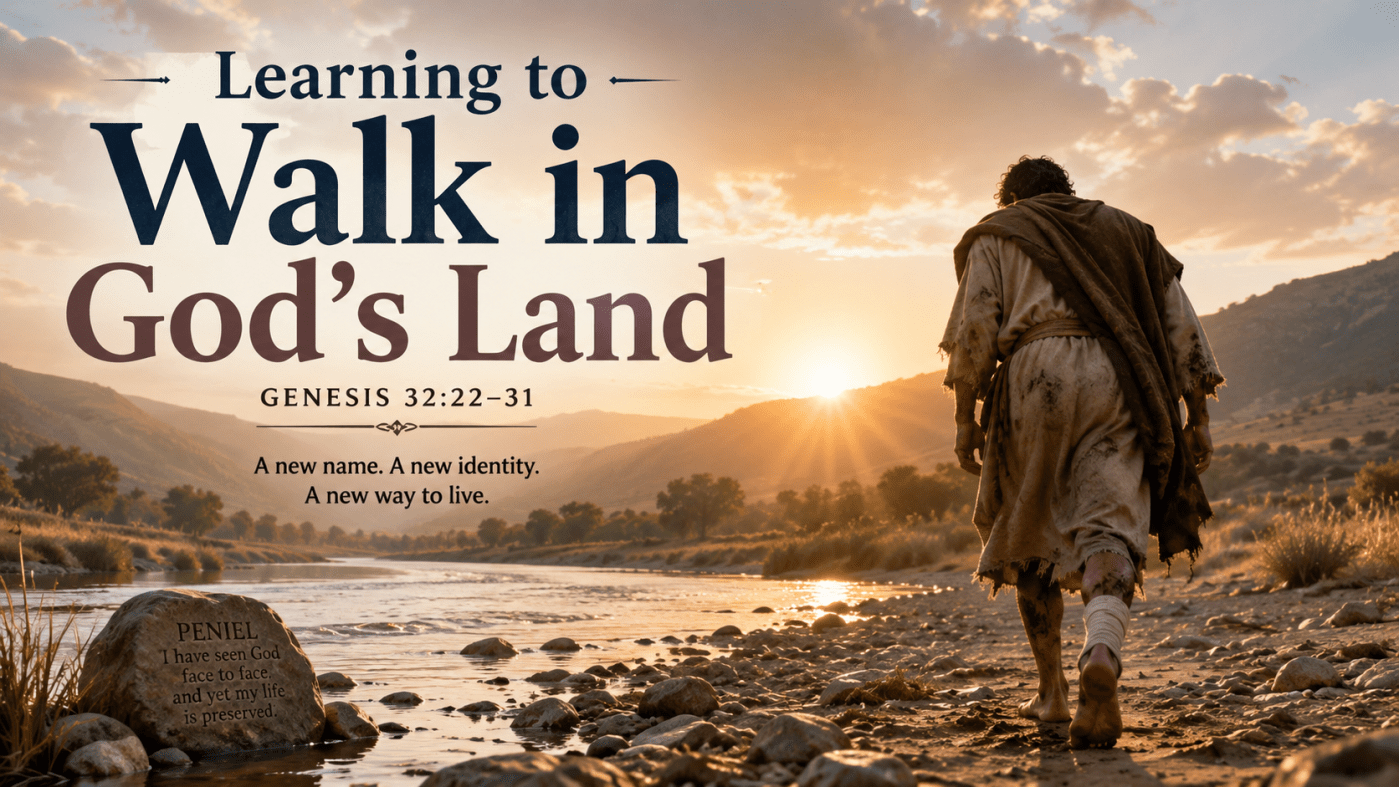
22 The same night he got up and took his two wives, his two maids, and his eleven children, and crossed the ford of the Jabbok. 23 He took them and sent them across the stream, and likewise everything that he had. 24 Jacob was left alone; and a man wrestled with him until daybreak. 25 When the man saw that he did not prevail against Jacob, he struck him on the hip socket; and Jacob’s hip was put out of joint as he wrestled with him. 26 Then he said, “Let me go, for the day is breaking.” But Jacob said, “I will not let you go, unless you bless me.” 27 So he said to him, “What is your name?” And he said, “Jacob.” 28 Then the man said, “You shall no longer be called Jacob, but Israel, for you have striven with God and with humans, and have prevailed.” 29 Then Jacob asked him, “Please tell me your name.” But he said, “Why is it that you ask my name?” And there he blessed him. 30 So Jacob called the place Peniel, saying, “For I have seen God face to face, and yet my life is preserved.” 31 The sun rose upon him as he passed Penuel, limping because of his hip.
Questions
- Who is the man that wrestles with Jacob?
- What is the significance of the sunrise that the man tells Jacob to release him?
- Why does Jacob want the man to bless him?
Background
Related Scriptures: Matthew 14:13–21; Revelation2, 14, 19:12-16
The man renaming Jacob is the blessing. Names had significance in the ancient world, they conveyed either descriptions of one’s character or destiny. The man taking away the name Jacob (deceiver) and replacing it with Israel (strives with God) reflects Jacob’s new identity as someone who no longer gets ahead by deception but now does so because he struggles with God.
It is probably significant that Jacob encounters the man as he is crossing the Jabbok River. This was seen as the boundary of Israel’s inheritance and Jacob has to wrestle with God prior to entering God’s land.
It is also significant that the man clearly could have overpowered Jacob at any point, the “wrestling match” is meant to test Jacob’s endurance and resolve not his strength.
Chrysostom: Do you see how God revealed the complete explanation of why he demonstrated such considerateness? At the same time God taught this good man [Jacob] through the imposition of the name [Israel] who it was that he had seen and had been allowed to hold on to. Recall the text says, “You will no longer be called Jacob but Israel.” Now Israel means “seeing God.” “Since you are privileged to see God, insofar as it is possible for a human being to see him, hence I also give you this name so that it may be clear to everyone in future that you were accorded a vision.” And he added, “For you have fought with God and will thus be powerful in dealing with human beings.” No longer have any fear or expect to suffer any harm from anyone. Having gained such might in the first place as to succeed in wrestling with God, much more will you prevail over human beings and prove superior to all.[1]
Reflection
The climax of the account of Jacob wrestling with the angel is that his name is changed. Prior to that night he was known as Jacob, the deceiver, and after that night he became Israel, contends with God. This is important because the ancient world placed more significance on names than we often do. Names were thought to either demonstrate one’s character or predict one’s destiny. In other words, a name shaped a person. So the story of Jacob becoming Israel is important because it is a complete change in identity. This is a story of Jacob laying aside the old man and becoming the new. It is also significant that the encounter happens at the Jabbok River which was the boundary of the Promised Land. This means that the story is about Jacob trying to enter God’s land but needing to lay down his old self to do so and to take on the identity that God gives him.
So who was Jacob prior to this encounter? As his name (deceiver) implies Jacob was a person always trying to manipulate the situation to his benefit. He was the person who would take advantage of his brother’s hunger to gain the larger portion of the inheritance. He was the person who would take advantage of his father’s age and failing eyesight to gain the blessing of prosperity. He was the person who might not outright steal what belonged to his father-in-law but he would pull out all the stops to ensure that he became wealthy at his father-in-law’s expense. Jacob placed his own wealth and prosperity ahead of everything, including his own family. His actions meant that he and his father-in-law parted on cold terms. And as he returned home Jacob was worried that his brother would take his life in vengeance for his behavior. Jacob’s life had been defined by selfishness, manipulation, greed, and deception and it left him alone and in fear. And I think that if you asked Jacob that night about his life choices he probably would have felt misunderstood and said he was only looking out for himself because no one else would.
But that night something changed. Jacob began grappling with a man who could clearly easily best him and in the end he was left limping and changed. Many of the years I have read this story I have read the angel’s words as, “you have grappled with God and been victorious.” But now I realize Israel was not victorious, but he did prevail. Israel prevailed because he endured. Even when he was clearly battered and beaten he held on. Israel limps away from this encounter to reunite with a brother who he is simply hoping will tolerate him and he is met with a brother who wants a loving reconciled relationship. I think the importance of this was to teach Israel, you have spent your life being Jacob and it has led you to a life of pain and fear, now when you endure with the Lord and begin to grow you encounter a life marked by love, grace, and forgiveness. Just like the angel could have easily destroyed Jacob but chose to bless him instead, Esau could have destroyed Israel and instead blessed him and offered a renewed connection. It seems that the wrestling match is not about Jacob winning but Israel learning what it means to walk with God. He learns he cannot rely on the tactics that had brought him to the Jabbok, instead he needed to begin learning how to live in God’s land.
We see this idea carried into the New Testament. In Matthew 14, Jesus asks the crowds to trust him for provision and not to selfishly look out for themselves. In Revelation we are told conquering in the lifestyle Jesus promotes results in a new name. All of this works together to teach us that when we are in God’s presence the strength we have relied on does not profit us. Instead, we must hold on to God and ask for God’s blessing so that our identity can be changed and we can learn to live in a land of peace and prosperity. The point is that we need to stop relying on our selfish tactics and begin seeking God’s blessing in living like God. We need to understand that this change will take endurance and may result in lingering difficulties. But the change in identity will be worth any hardship we endure since we will find great blessings in the love and generosity of God.
[1] Mark Sheridan, ed., Genesis 12–50, Ancient Christian Commentary on Scripture 222.
 Squinting in the Light
Leave a comment