
Warning this post is about sexual assault, I try not to be graphic but it is difficult content
I saw this post on X the day Mike wrote it, but I have not had time until now to fully express my thoughts about it.
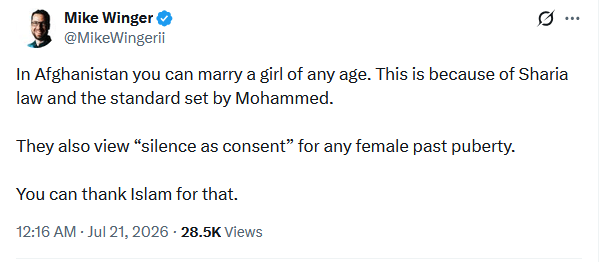
I want to begin charitably by saying that I applaud Mike for affirming the principle that “silence is not consent”. He is completely right about that, and I think that is where the conversation should begin. I say this because protecting people from sexual violence should be a priority for all of us. Our culture needs to do a better job of recognizing this basic principle and allowing it to shape the way we understand and evaluate sexual encounters.
However, as much as I want to celebrate Mike’s post for taking a stand against sexual violence, I have a significant concern: his post appears to apply this principle specifically to Islam.
Now, sexual violence is, from what I understand, a serious problem in some Muslim communities. I am not Muslim, nor do I know enough about the internal diversity of Islam to make broad claims about how widespread particular beliefs or practices are. But that uncertainty actually reinforces my concern. I do know that the problem is not universal within Islam, yet Mike’s post seems to frame it as though it is.
There is an important distinction between saying some Muslims or some Muslim communities hold beliefs that can contribute to sexual violence and saying Islam itself universally teaches or promotes those beliefs. Those are very different claims. If we are going to be honest Christians, we should acknowledge how important this distinction is.
We undermine our own credibility when we make sweeping claims about another religious tradition that are not grounded in reality. Jesus tells us to treat others as we want to be treated. If we would object to someone condemning all Christians because of the beliefs or practices of a particular subset of Christians, then we should be cautious about doing the same thing to Muslims.
But there is an even more concerning issue with Mike’s argument- there are Christians who believe that silence is consent.
Recognizing our own community has people who believe this, then perhaps we should confront that problem before pointing to another religious community. Jesus’ teaching about removing the log from our own eye before attempting to remove the speck from someone else’s seems particularly relevant here.
And this brings me back to Mike’s own standard: “silence is not consent.”
If we are going to establish that as a moral principle, we should apply it consistently—even when doing so makes Christians uncomfortable.
Consider the story of David and Bathsheba in 2 Samuel 11. I have written about this passage before here. The text tells us that David sees Bathsheba, summons her, and has sexual relations with her. Bathsheba never gives an explicit indication of consent. In fact, the text goes out of its way to make her seem as though she is not complicit in this action.
Yet when this passage is discussed among many Christians, the sin is usually described simply as adultery. And when someone raises the possibility that David sexually assaulted Bathsheba, a common response is that Bathsheba came to David when he summoned her, and therefore must have consented to the encounter.
But being summoned by the king is not consent to a sexual encounter.
If silence is not consent, then neither is obedience to a powerful person’s command to enter his presence. Bathsheba’s appearance at the palace after David summoned her cannot, by itself, establish consent for a sexual encounter. The fact that David was the king only makes the power imbalance more significant.
This raises an uncomfortable question: Why are some Christians so resistant to describing David’s actions toward Bathsheba as sexual assault?
Even more significantly, when Mike himself discusses this story, he describes David and Bathsheba as having “commit adultery together” (here at approximately the 45:00 mark). Why is Mike so uncomfortable with the sexual violence in this passage that he abandons his standard that “silence is not consent”? If Mike’s standard is that silence is not consent, then it seems inconsistent to describe Bathsheba as a willing participant in David’s actions without establishing that she actually consented.
That inconsistency is the larger issue for me.
When someone establishes a moral standard and then uses that standard primarily to criticize people outside his own community, while failing to apply the same standard to people within his community—or even to his own interpretation of Scripture—it makes me less inclined to trust that person or the group he represents. I am sure I am not alone in this, I am sure there are many people who feel less comfortable with Christianity for precisely this reason.
Yes, there are serious problems that need to be confronted within some Muslim communities. But how can Christians effectively criticize those problems while there are Christians within our own communities promoting ideas such as, “There is no such thing as marital rape”? How can we condemn sexual coercion in another religious tradition while some Christians argue that women somehow consent to sexual violence because of what they wear?
If our concern is genuinely that “silence is not consent”, then that principle should not stop at the boundaries of our own religious community.
This is ultimately my problem with Mike’s comment. I agree with the underlying principle. I agree that silence is not consent, and I believe Christians should be among the strongest voices defending that principle.
But precisely because I agree with the principle of this post, I wish Mike would spend more time making sure that Christians live up to this standard before using it primarily as a weapon against people outside the Church.
We have enough Christians who still do not understand that silence is not consent. We have enough Christian women who have experienced coercion, sexual violence, or the denial of their own agency. We have enough people within our own churches who need to hear this message. So rather than lumping Islam as a whole into a category defined by the actions or beliefs of some Muslims, I would rather see Christians consistently apply the same moral standard to ourselves. We should confront sexual violence and coercion whenever it occurs occur—including within the Church. We should make our churches places where women are believed, protected, respected, and free from coercion.
So yes, I agree with Mike’s central theme: “silence is not consent”.
I simply wish he would spend more time making sure that the people in his own camp live up to that standard before criticizing those outside it for failing to do so.


Leave a Reply